Schinkenhäger | 1979
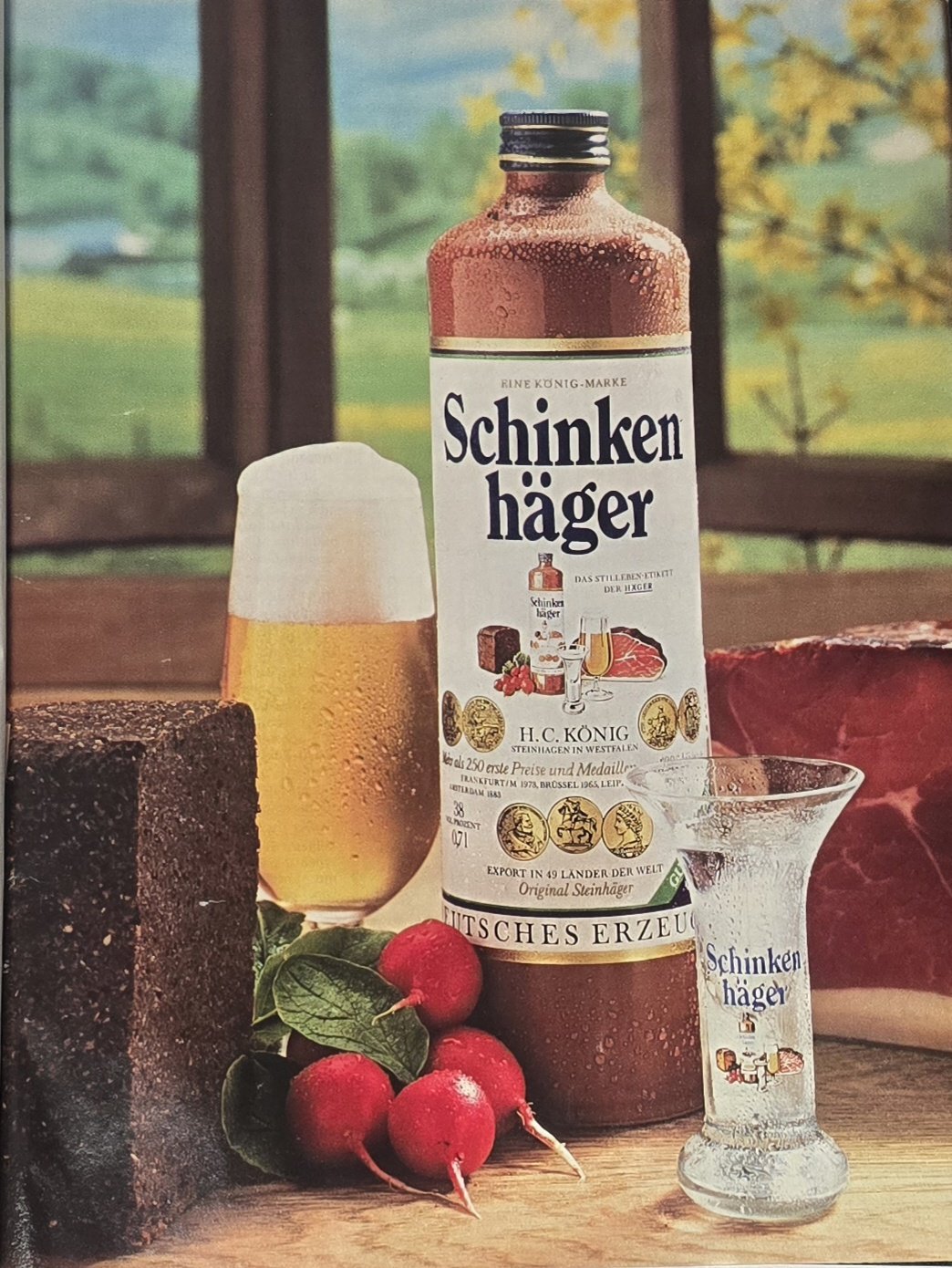
No headline, no slogan: just a Westphalian table. Rye bread, raw ham, radishes, a glass of beer and a tall clay-coloured bottle of Schinkenhäger, in this ad from 1979.
Schinkenhäger is a Steinhäger, a juniper spirit, a German cousin of gin, from the small town of Steinhagen near Bielefeld. Distillers there have made it since the 17th century; in the 19th century the town had around twenty distilleries. The König family was one of them, and its firm, H.C. König, made this brand. Steinhäger was traditionally sold in stoneware bottles, and since 1989 only spirits made in Steinhagen may carry the name.
In this ad we can see a curious detail: the label shows the same still life as the photo, the bottle surrounded by bread, ham and beer. The name itself joins the drink to the table: Schinken means ham. The label also boasts more than 250 prizes and medals and exports to 49 countries.
In 1985 the two largest Steinhäger distilleries, H.C. König and Schlichte, merged. Only a few producers remain today. The ad shows a time when a schnapps with beer was a normal part of a hearty meal, a habit we look at more carefully now.
Have you ever seen this bottle on a Westphalian table?
Text in the ad
Eine König-Marke
Schinkenhäger
Das Stilleben-Etikett der Häger
H. C. König · Steinhagen in Westfalen
Mehr als 250 erste Preise und Medaillen
Export in 49 Länder der Welt · Original Steinhäger · Deutsches Erzeugnis
Translation:
A König brand
Schinkenhäger
The still-life label of the Häger
H. C. König · Steinhagen in Westphalia
More than 250 first prizes and medals
Exported to 49 countries worldwide · Original Steinhäger · Made in Germany
- Brand
- Schinkenhäger
- Year
- 1979
- Decade
- 1970s
- Country
- Germany
- Medium
- Magazine
- Themes
- Drinks, Food
- Original publication
- Der Spiegel, 1979

