Tio Pepe | 1979
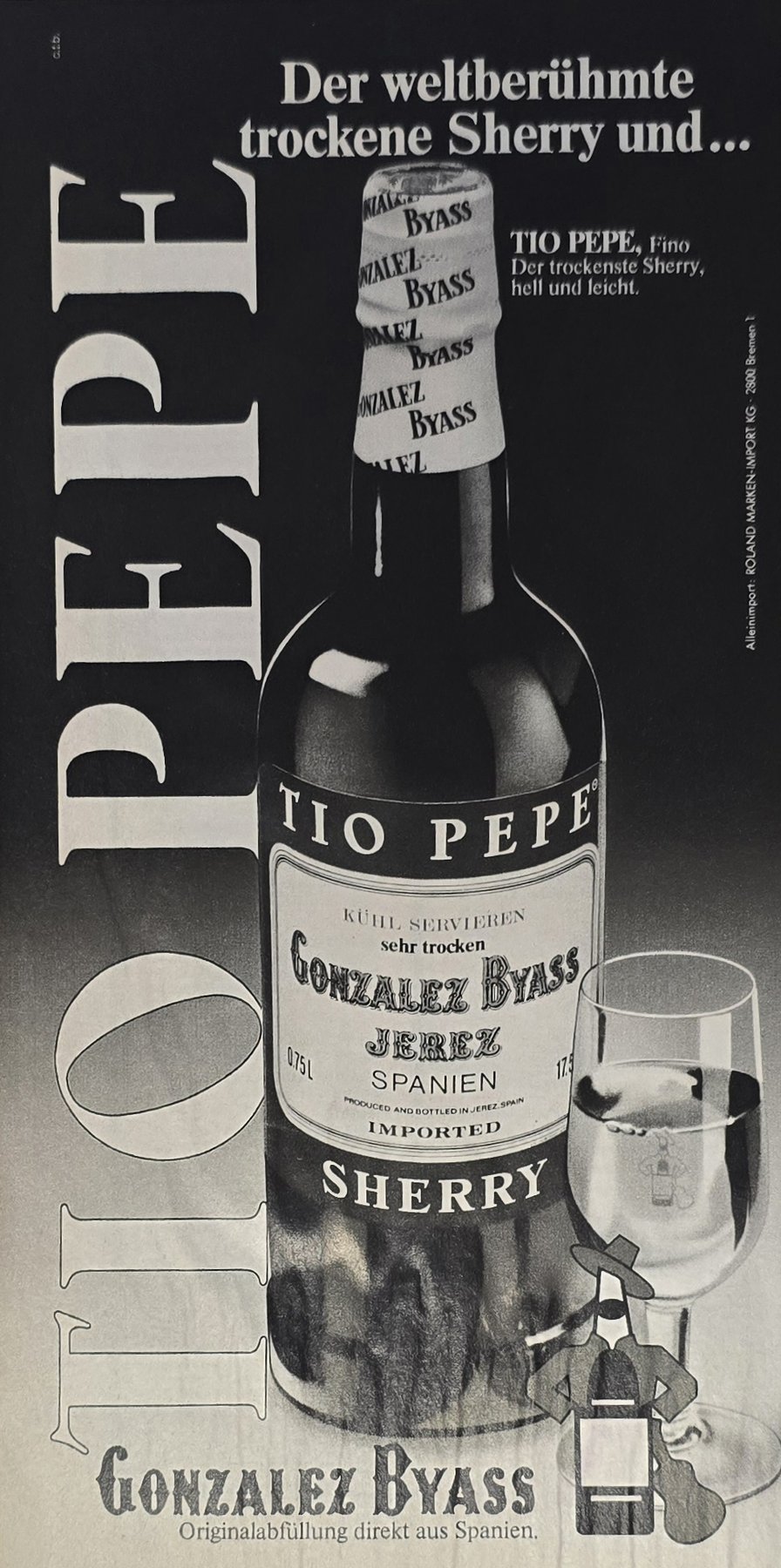
How do you sell a Spanish wine to German readers? With a bottle wearing a hat. In the corner of this 1979 ad, the Tio Pepe figure stands with his wide-brimmed hat, short jacket and guitar.
The story begins in Jerez de la Frontera in 1835. Manuel María González Ángel, a 23-year-old with no experience in wine, started his business with the advice of his maternal uncle, José Ángel y Vargas. He called him «tío Pepe», Uncle Pepe, and named his fino sherry after him. His English agent, Robert Blake Byass, later became his partner, and the company took the name González Byass.
The figure in the ad was born in 1935, for the company's 100th anniversary. Its head of advertising, Luis Pérez Solero, dressed the bottle as an Andalusian. Since 1957 a giant Tio Pepe sign has stood over the Puerta del Sol in Madrid.
In this ad we can see how the sherry reached Germany: «Originalabfüllung direkt aus Spanien», bottled in Spain, imported through Bremen, with a reminder to serve it chilled. González Byass is still run by the González family, now in its fifth generation.
And you, have you ever seen the man with the guitar over the Puerta del Sol?
Text in the ad
Der weltberühmte trockene Sherry und…
TIO PEPE, Fino. Der trockenste Sherry, hell und leicht.
TIO PEPE · Kühl servieren · sehr trocken · Gonzalez Byass · Jerez · Spanien · Sherry
Gonzalez Byass. Originalabfüllung direkt aus Spanien.
Alleinimport: Roland Marken-Import KG · 2800 Bremen 1
Translation:
The world-famous dry sherry and…
TIO PEPE, Fino. The driest sherry, pale and light.
TIO PEPE · Serve chilled · very dry · Gonzalez Byass · Jerez · Spain · Sherry
Gonzalez Byass. Original bottling direct from Spain.
Sole importer: Roland Marken-Import KG · 2800 Bremen 1
- Brand
- Tio Pepe
- Year
- 1979
- Decade
- 1970s
- Country
- Germany
- Medium
- Magazine
- Themes
- Drinks
- Original publication
- Der Spiegel, 1979

