Olympus OM-1 | 1979
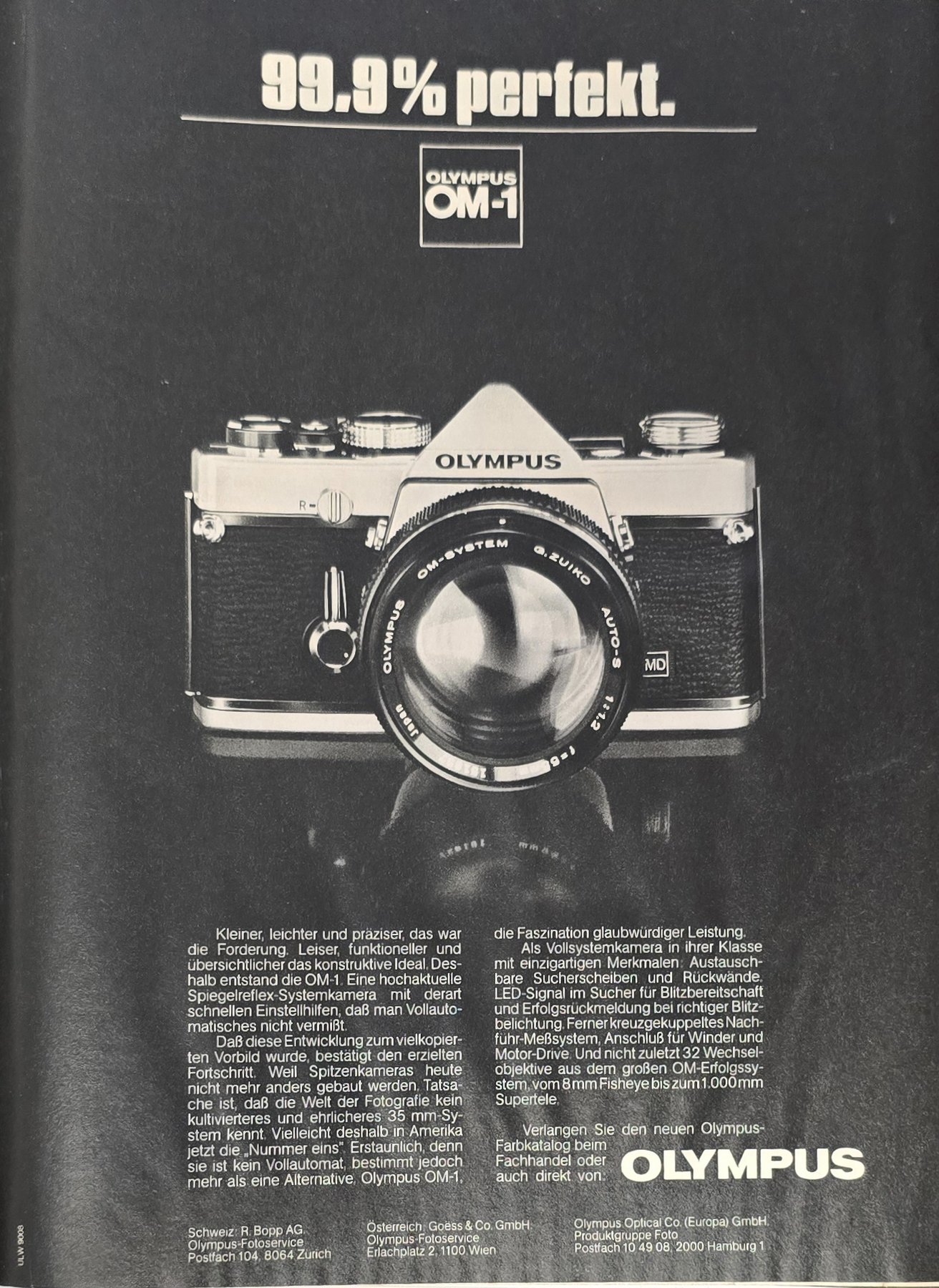
«99,9 % perfekt.» (99.9 % perfect.) Olympus gave its own camera a grade in this 1979 ad, leaving a tenth of a point for modesty.
The OM-1 was the work of Yoshihisa Maitani, an Olympus designer who believed a professional camera could be small and light. He spent about five years on it. In 1972 he presented it at Photokina in Cologne as the «M-1», but Leitz protested because of its own Leica M cameras. Olympus renamed it OM-1.
In this ad we can see what Olympus was selling to German readers: «smaller, lighter and more precise», with an «MD» badge for the optional motor drive. The copy even admits, almost proudly, that the OM-1 is not fully automatic. In 1979, when automatic cameras were spreading, that was a statement.
Olympus left the camera business in 2021 and sold it to the investor Japan Industrial Partners. The new company is called OM Digital Solutions, a name chosen to honour the OM system. Many say the letters stand for «Olympus Maitani».
In 2022 the story came full circle: the first camera under the new OM System brand was called, once again, OM-1.
Text in the ad
99,9 % perfekt.
Olympus OM-1
Kleiner, leichter und präziser, das war die Forderung. Leiser, funktioneller und übersichtlicher das konstruktive Ideal. Deshalb entstand die OM-1. Eine hochaktuelle Spiegelreflex-Systemkamera mit derart schnellen Einstellhilfen, daß man Vollautomatisches nicht vermißt.
Daß diese Entwicklung zum vielkopierten Vorbild wurde, bestätigt den erzielten Fortschritt. Weil Spitzenkameras heute nicht mehr anders gebaut werden. Tatsache ist, daß die Welt der Fotografie kein kultivierteres und ehrlicheres 35-mm-System kennt. Vielleicht deshalb in Amerika jetzt die „Nummer eins“. Erstaunlich, denn sie ist kein Vollautomat, bestimmt jedoch mehr als eine Alternative, Olympus OM-1, die Faszination glaubwürdiger Leistung.
Als Vollsystemkamera in ihrer Klasse mit einzigartigen Merkmalen: Austauschbare Sucherscheiben und Rückwände. LED-Signal im Sucher für Blitzbereitschaft und Erfolgsrückmeldung bei richtiger Blitzbelichtung. Ferner kreuzgekuppeltes Nachführ-Meßsystem, Anschluß für Winder und Motor-Drive. Und nicht zuletzt 32 Wechselobjektive aus dem großen OM-Erfolgssystem, vom 8-mm-Fisheye bis zum 1.000-mm-Supertele.
Verlangen Sie den neuen Olympus-Farbkatalog beim Fachhandel oder auch direkt von: Olympus
Olympus Optical Co. (Europa) GmbH, Produktgruppe Foto, 2000 Hamburg 1
Translation:
99.9% perfect.
Olympus OM-1
Smaller, lighter and more precise: that was the demand. Quieter, more functional and clearer: the design ideal. That is how the OM-1 came about. A thoroughly up-to-date single-lens reflex system camera with focusing aids so fast that you don’t miss full automation.
The fact that this design became a much-copied model confirms the progress achieved. Because top cameras are no longer built any other way. The fact is that the world of photography knows no more refined and honest 35 mm system. Perhaps that is why it is now “number one” in America. Surprising, since it is not fully automatic – but certainly more than an alternative: Olympus OM-1, the fascination of credible performance.
A full system camera in its class with unique features: interchangeable focusing screens and backs. LED signal in the viewfinder for flash readiness and confirmation of correct flash exposure. Also a cross-coupled follow-needle metering system, connection for winder and motor drive. And not least 32 interchangeable lenses from the great OM system, from 8 mm fisheye to 1,000 mm super telephoto.
Ask your specialist dealer for the new Olympus colour catalogue, or get it directly from: Olympus
Olympus Optical Co. (Europa) GmbH, Photo Division, 2000 Hamburg 1
- Brand
- Olympus
- Year
- 1979
- Decade
- 1970s
- Country
- Germany
- Medium
- Magazine
- Themes
- Technology
- Original publication
- Der Spiegel, 1979

