Robot Royal | 1953
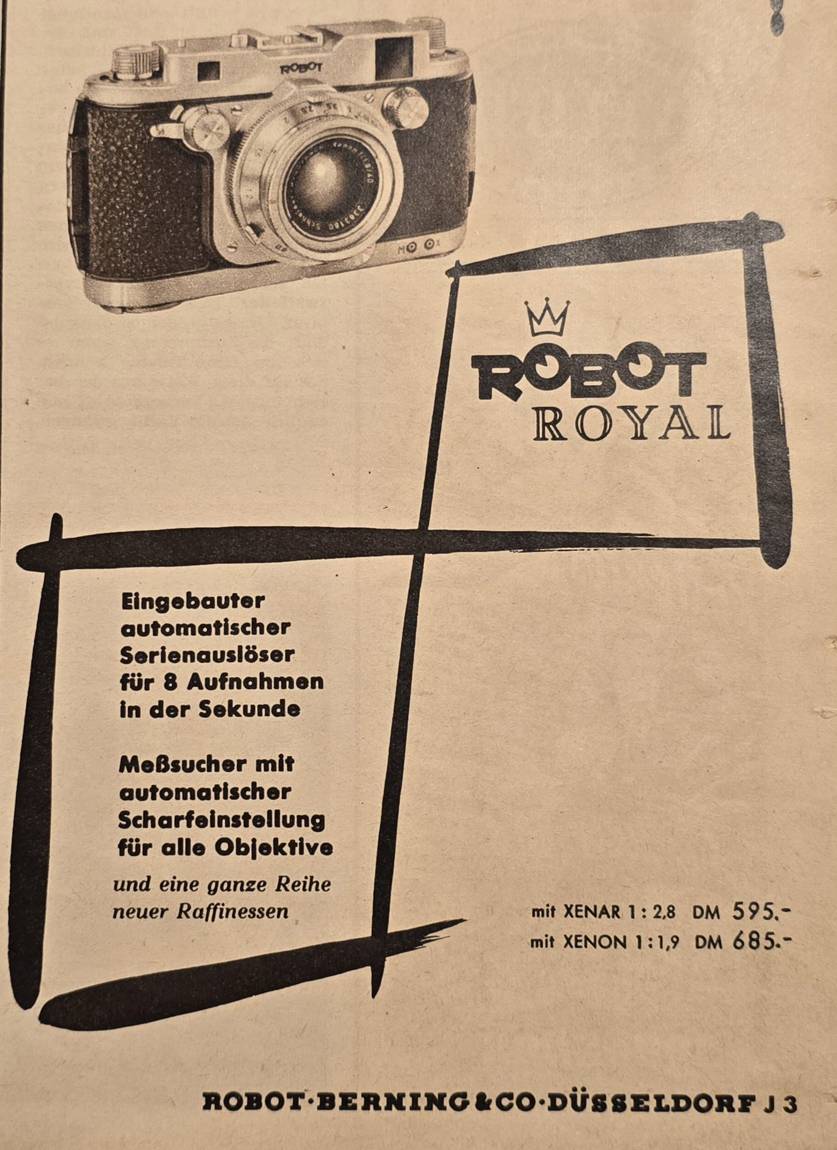
Eight pictures a second, in 1953. The Robot Royal had a clockwork spring motor built in: wind it up, hold the button and the camera fired a burst, decades before motor drives became common. Owners today measure something closer to six frames a second, but the promise was spectacular.
The idea came from Heinz Kilfitt, a watchmaker’s son, who designed a small motorised camera taking square 24 × 24 mm pictures. Kodak and Agfa turned it down; the young Hans Berning backed it, and in 1934 Otto Berning & Co. in Düsseldorf launched the first Robot. During the Second World War the Robot II was used by the Luftwaffe.
The ad promises a “Meßsucher mit automatischer Scharfeinstellung” (rangefinder with automatic focusing). It was not autofocus: the rangefinder was coupled to the lens, and you focused by lining up two images in the viewfinder.
The Robot Royal was a luxury: the version with the fast Schneider Xenon lens cost DM 685, more than the most expensive SABA radio advertised in the same issue.
Later, Robot specialised in cameras for surveillance and traffic control. Since 1999 it has been part of the Jenoptik group.
Text in the ad
Robot Royal
Eingebauter automatischer Serienauslöser für 8 Aufnahmen in der Sekunde
Meßsucher mit automatischer Scharfeinstellung für alle Objektive
und eine ganze Reihe neuer Raffinessen
mit Xenar 1:2,8 DM 595.– · mit Xenon 1:1,9 DM 685.–
Robot-Berning & Co · Düsseldorf
Translation:
Robot Royal
Built-in automatic burst release for 8 shots per second
Rangefinder with automatic focusing for all lenses
and a whole range of new refinements
with Xenar f/2.8 DM 595 · with Xenon f/1.9 DM 685
Robot-Berning & Co · Düsseldorf
- Brand
- Robot Royal
- Year
- 1953
- Decade
- 1950s
- Country
- Germany
- Medium
- Magazine
- Themes
- Technology
- Original publication
- Hören und Sehen, 1953

