Aero Willys | 1962
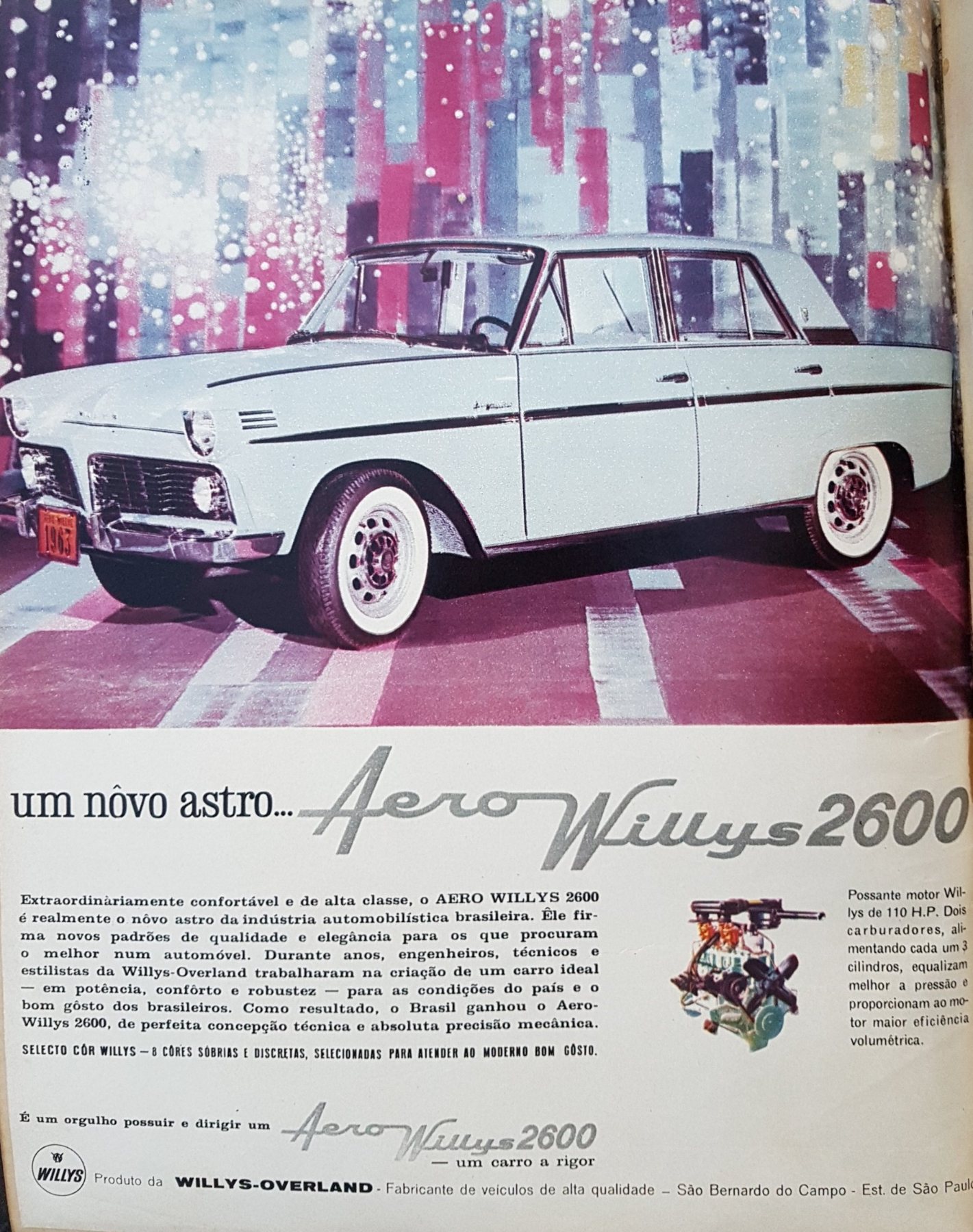
One of those unmissable 1960s car ads, for lovers of cars and advertising alike.
Willys-Overland do Brasil was founded on 26 April 1952 in São Bernardo do Campo, São Paulo, and began in 1954 by assembling the Jeep Willys, soon known for its toughness.
In 1960 Brazil’s young car industry still had few models. The Brazilian Aero-Willys was presented on 25 March 1960, 85.3% locally made. Similar to the American Aero Wing, it was a four-door saloon with features new to Brazil: an aerodynamic profile, bonnet and boot lower than the wings, and a large glass area.
It seated six in relative comfort. The engine was the Jeep’s 2.6-litre straight six, with 90 hp and a three-speed gearbox. For 1962 the Aero got new wheels and hubcaps, side trim, a padded dashboard and new colours.
That September the Aero-Willys 2600, completely redesigned by Brazilian stylists, was a success at the third São Paulo Motor Show.
Text in the ad
Orgulhosamente seu
Aero-Willys ’62… símbolo do sucesso. Elegante, sua esmerada produção generosamente se espelha em cada pormenor, da seleção de côres aos materiais empregados. Potência e desempenho superiores, excepcional economia, moderno confôrto. Na plenitude de suas muitas qualidades reais, que o distinguem entre os carros de classe, eis o Aero-Willys ’62
Um produto da Willys-Overland – São Bernardo do Campo, Estado de São Paulo
Translation:
Proudly yours
Aero-Willys ’62… a symbol of success. Elegant, its careful construction shows generously in every detail, from the choice of colours to the materials used. Superior power and performance, exceptional economy, modern comfort. In the fullness of its many real qualities, which set it apart among fine cars, here is the Aero-Willys ’62
A Willys-Overland product – São Bernardo do Campo, São Paulo State
- Brand
- Aero Willys
- Year
- 1962
- Decade
- 1960s
- Country
- Brazil
- Medium
- Magazine
- Themes
- Cars

