F. Jahnel | 1887

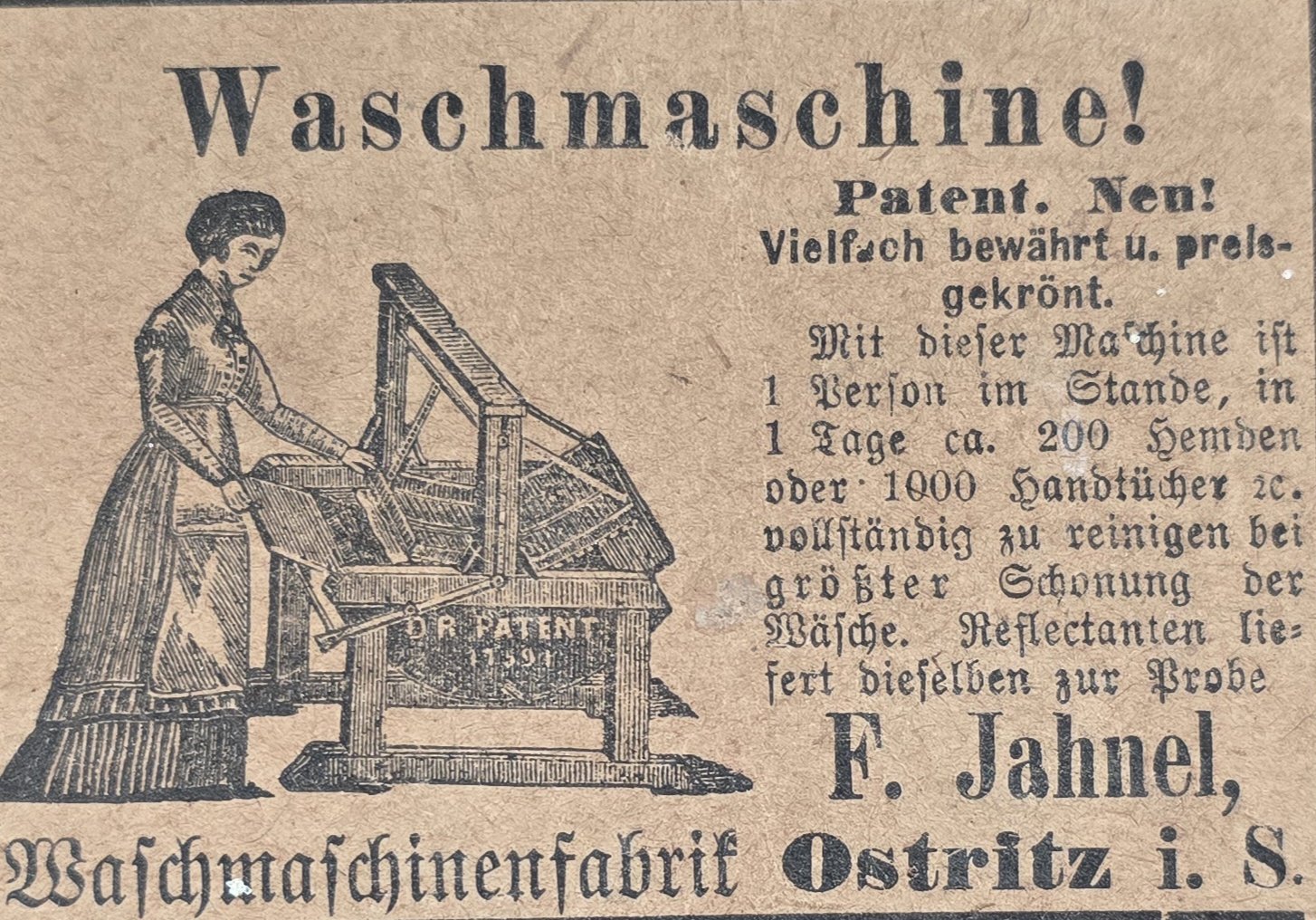
1887 German newspaper ad. Engraving of a woman in a long dress operating a large wooden hand-powered washing machine with a lever. Headline “Waschmaschine!” and text in Gothic type naming F. Jahnel, Waschmaschinenfabrik, Ostritz i. S.

“Waschmaschine!” In 1887, F. Jahnel's washing-machine factory in Ostritz, Saxony, claimed that with its new, patented and prize-winning machine one person could wash about 200 shirts or 1,000 hand towels a day, “with the greatest care for the laundry”, and offered it on trial.

In this ad we can see that the machine is made of wood and worked by hand with a lever: no motor, no electricity.

We also see who does the work: a woman. Washing day was women's work, long and heavy, so a machine that saved arms was news.

Electric washing machines only became common in German homes in the second half of the 20th century.

Text in the ad

Waschmaschine!
Patent. Neu!
Vielfach bewährt u. preisgekrönt.
Mit dieser Maschine ist 1 Person im Stande, in 1 Tage ca. 200 Hemden oder 1000 Handtücher etc. vollständig zu reinigen bei größter Schonung der Wäsche. Reflectanten liefert dieselben zur Probe
F. Jahnel,
Waschmaschinenfabrik Ostritz i. S.

Translation:
Washing machine!
Patented. New!
Proven many times over and prize-winning.
With this machine, 1 person can thoroughly clean about 200 shirts or 1,000 hand towels etc. in 1 day, with the greatest care for the laundry. Supplied on trial to interested parties by
F. Jahnel,
Washing-machine factory, Ostritz, Saxony.

Brand
F. Jahnel
Year
1887
Decade
19th century
Country
Germany
Medium
Newspaper
Themes
Home, Technology
Original publication
Zeitungs-Umschläge für Sächs. Provinzial- u. Grenzstädte, Dresden, 1887
F. Jahnel | 1887 · Vintage Ad Museum
Vintage Ad Museum · Museu da Propaganda, since 1999
{{ l.code }}
{{ T.heroEyebrow }}

{{ T.heroTitle }}

{{ T.heroLede }}

{{ h.alt }}
{{ T.weekPiece }} {{ h.title }} {{ h.meta }} {{ h.excerpt }} {{ T.readPiece }} →

{{ T.browse }}

{{ totalLine }}

{{ T.byDecade }}

{{ T.byCountry }}

{{ T.byTheme }}

{{ T.byMedium }}

{{ T.seriesLabel }}

{{ T.natal }}

{{ T.natalLede }}

{{ T.seriesLabel }}

{{ T.didYouKnow }}

{{ k.title }} {{ k.text }}
{{ T.archiveEyebrow }}

{{ T.nav.archive }}

{{ resultLine }}

{{ T.noResults }}

{{ T.timelineEyebrow }}

{{ T.nav.timeline }}

{{ T.timelineLede }}

{{ d.big }} {{ d.label }} · {{ d.count }}
{{ T.nav.about }}

{{ T.aboutTitle }}

{{ p }}

{{ T.founderLabel }}

{{ T.founder }}

Vintage Ad Museum · Museu da Propaganda, since 1999
{{ p.t }} {{ p.d }}
Vintage Ad Museum · Museu da Propaganda, since 1999
Vintage Ad Museum {{ n.label }}
{{ T.languages }} {{ l.label }}

{{ T.footerAbout }}

© 1999–2026 Vintage Ad Museum · Museu da Propaganda, since 1999 · vintageadmuseum.com{{ path }}
vintageadmuseum.com{{ path }}
{{ im.alt }} {{ zoomHint }}

{{ pv.title }}

{{ T.listen }}

{{ T.ptOnly }}

{{ p }}

{{ T.adTexts }}
{{ pv.adOrigLabel }}

{{ l }}

{{ T.translation }}

{{ l }}

{{ T.sensitive }}

{{ m.k }}
{{ m.v }}
{{ T.share }}
{{ r.title }}