Hanomag | 1930
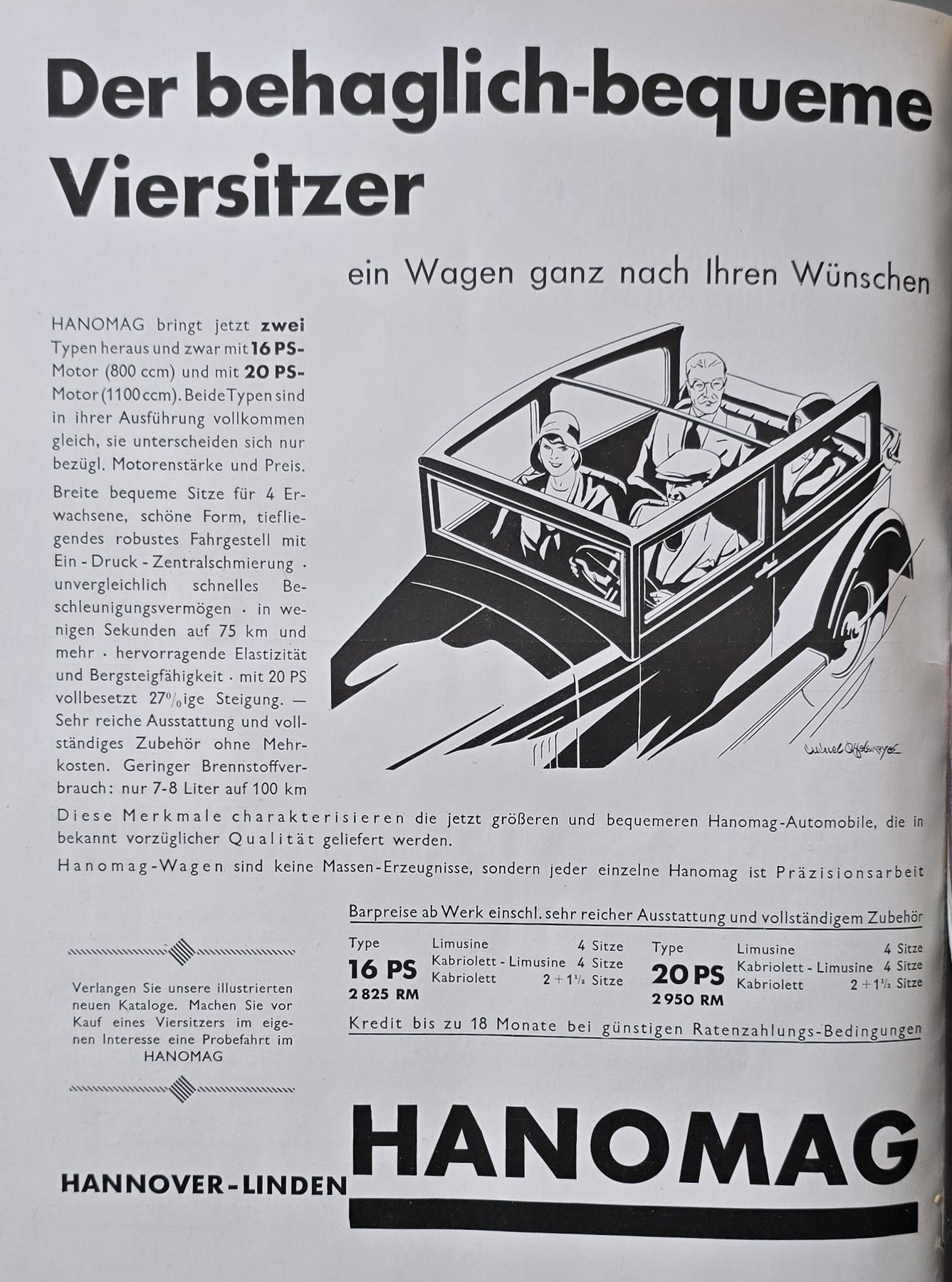
“Der behaglich-bequeme Viersitzer”: the cosy, comfortable four-seater. In 1930, Hanomag of Hannover-Linden launched two cars with the same body: one with a 16 hp, 800 cc engine for 2,825 Reichsmarks, and one with 20 hp and 1,100 cc for 2,950, with credit over up to 18 months.
Hanomag goes back to an iron foundry founded by Georg Egestorff in Linden in 1835 and made locomotives and tractors. Its first car, the 2/10 PS of 1925, was nicknamed “Kommissbrot”, army loaf, for its boxy shape.
The ad insists the cars are not mass products: “every single Hanomag is precision work”. In 1930 the brand was second in the German car market, behind Opel.
Hanomag stopped making cars in 1941; the Linden works closed after bankruptcy in 1983.
Text in the ad
Der behaglich-bequeme Viersitzer
ein Wagen ganz nach Ihren Wünschen
HANOMAG bringt jetzt zwei Typen heraus und zwar mit 16 PS-Motor (800 ccm) und mit 20 PS-Motor (1100 ccm). Beide Typen sind in ihrer Ausführung vollkommen gleich, sie unterscheiden sich nur bezügl. Motorenstärke und Preis.
Breite bequeme Sitze für 4 Erwachsene, schöne Form, tiefliegendes robustes Fahrgestell mit Ein-Druck-Zentralschmierung · unvergleichlich schnelles Beschleunigungsvermögen · in wenigen Sekunden auf 75 km und mehr · hervorragende Elastizität und Bergsteigfähigkeit · mit 20 PS vollbesetzt 27%ige Steigung. – Sehr reiche Ausstattung und vollständiges Zubehör ohne Mehrkosten. Geringer Brennstoffverbrauch: nur 7-8 Liter auf 100 km
Diese Merkmale charakterisieren die jetzt größeren und bequemeren Hanomag-Automobile, die in bekannt vorzüglicher Qualität geliefert werden.
Hanomag-Wagen sind keine Massen-Erzeugnisse, sondern jeder einzelne Hanomag ist Präzisionsarbeit
Barpreise ab Werk einschl. sehr reicher Ausstattung und vollständigem Zubehör: Type 16 PS – 2825 RM (Limusine 4 Sitze · Kabriolett-Limusine 4 Sitze · Kabriolett 2 + 1½ Sitze) · Type 20 PS – 2950 RM (Limusine 4 Sitze · Kabriolett-Limusine 4 Sitze · Kabriolett 2 + 1½ Sitze)
Kredit bis zu 18 Monate bei günstigen Ratenzahlungs-Bedingungen
Verlangen Sie unsere illustrierten neuen Kataloge. Machen Sie vor Kauf eines Viersitzers im eigenen Interesse eine Probefahrt im HANOMAG
HANNOVER-LINDEN · HANOMAG
Translation:
The cosy, comfortable four-seater
a car just the way you want it
HANOMAG is now launching two types, with a 16 hp engine (800 cc) and with a 20 hp engine (1,100 cc). Both types are completely identical in design and differ only in engine power and price.
Wide, comfortable seats for 4 adults, a handsome shape, a low, sturdy chassis with one-shot central lubrication · incomparably quick acceleration · up to 75 km/h and more in a few seconds · excellent flexibility and hill-climbing ability · with 20 hp, fully loaded, a 27% gradient. – Very rich equipment and full accessories at no extra cost. Low fuel consumption: only 7–8 litres per 100 km
These features characterise the now larger and more comfortable Hanomag automobiles, delivered in their well-known excellent quality.
Hanomag cars are not mass products; every single Hanomag is precision work
Cash prices ex works, including very rich equipment and full accessories: 16 hp type – 2,825 RM (saloon 4 seats · convertible saloon 4 seats · convertible 2 + 1½ seats) · 20 hp type – 2,950 RM (saloon 4 seats · convertible saloon 4 seats · convertible 2 + 1½ seats)
Credit for up to 18 months on favourable instalment terms
Ask for our new illustrated catalogues. In your own interest, take a test drive in a HANOMAG before buying a four-seater
HANNOVER-LINDEN · HANOMAG
- Brand
- Hanomag
- Year
- 1930
- Decade
- 1930s
- Country
- Germany
- Medium
- Magazine
- Themes
- Cars
- Original publication
- Die Koralle, 1930

