Wichern-Stiftung | 1930
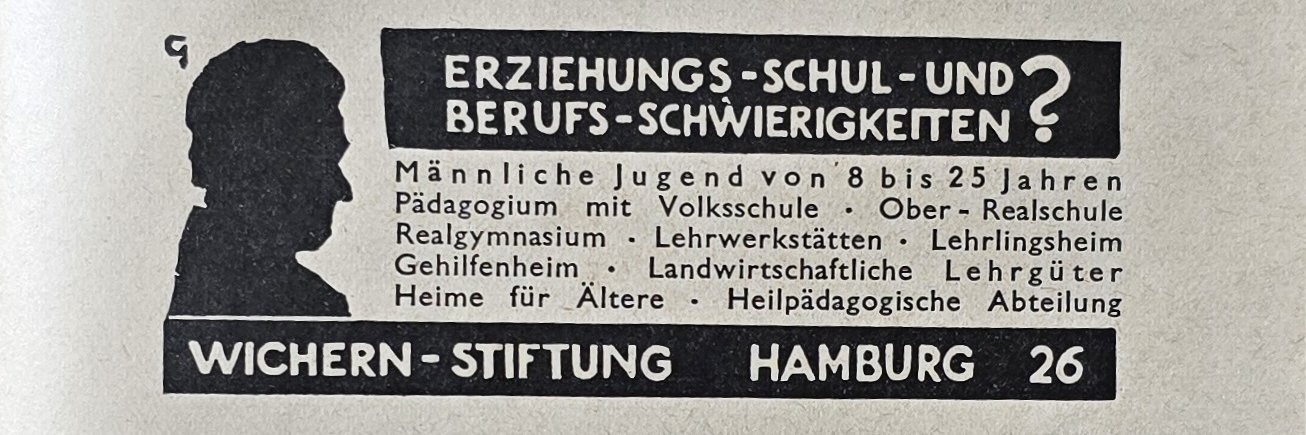
“Erziehungs-, Schul- und Berufs-Schwierigkeiten?”: trouble with upbringing, school or work? In 1930, the Wichern-Stiftung in Hamburg advertised to parents of boys and young men aged 8 to 25.
It offered a whole world under one roof: a primary school, secondary schools, training workshops, homes for apprentices and assistants, farm estates for agricultural training and a special-needs department.
The name honours Johann Hinrich Wichern, the Hamburg theologian who in 1833 founded the Rauhes Haus, a home for neglected children that became a model for Protestant social work in Germany.
The silhouette of a young man and the question mark show a worry of every era: what to do when a son does not fit in at school.
Text in the ad
Erziehungs-, Schul- und Berufs-Schwierigkeiten?
Männliche Jugend von 8 bis 25 Jahren
Pädagogium mit Volksschule · Ober-Realschule · Realgymnasium · Lehrwerkstätten · Lehrlingsheim · Gehilfenheim · Landwirtschaftliche Lehrgüter · Heime für Ältere · Heilpädagogische Abteilung
Wichern-Stiftung Hamburg 26
Translation:
Difficulties with upbringing, school or work?
Boys and young men aged 8 to 25
Boarding school with primary school · Upper secondary school (Oberrealschule) · Grammar school (Realgymnasium) · Training workshops · Apprentices' home · Journeymen's home · Agricultural training estates · Homes for older youths · Special-needs education department
Wichern-Stiftung, Hamburg 26
- Brand
- Wichern-Stiftung
- Year
- 1930
- Decade
- 1930s
- Country
- Germany
- Medium
- Magazine
- Themes
- Childhood
- Original publication
- Die Koralle, 1930

