Peugeot 202 | 1939

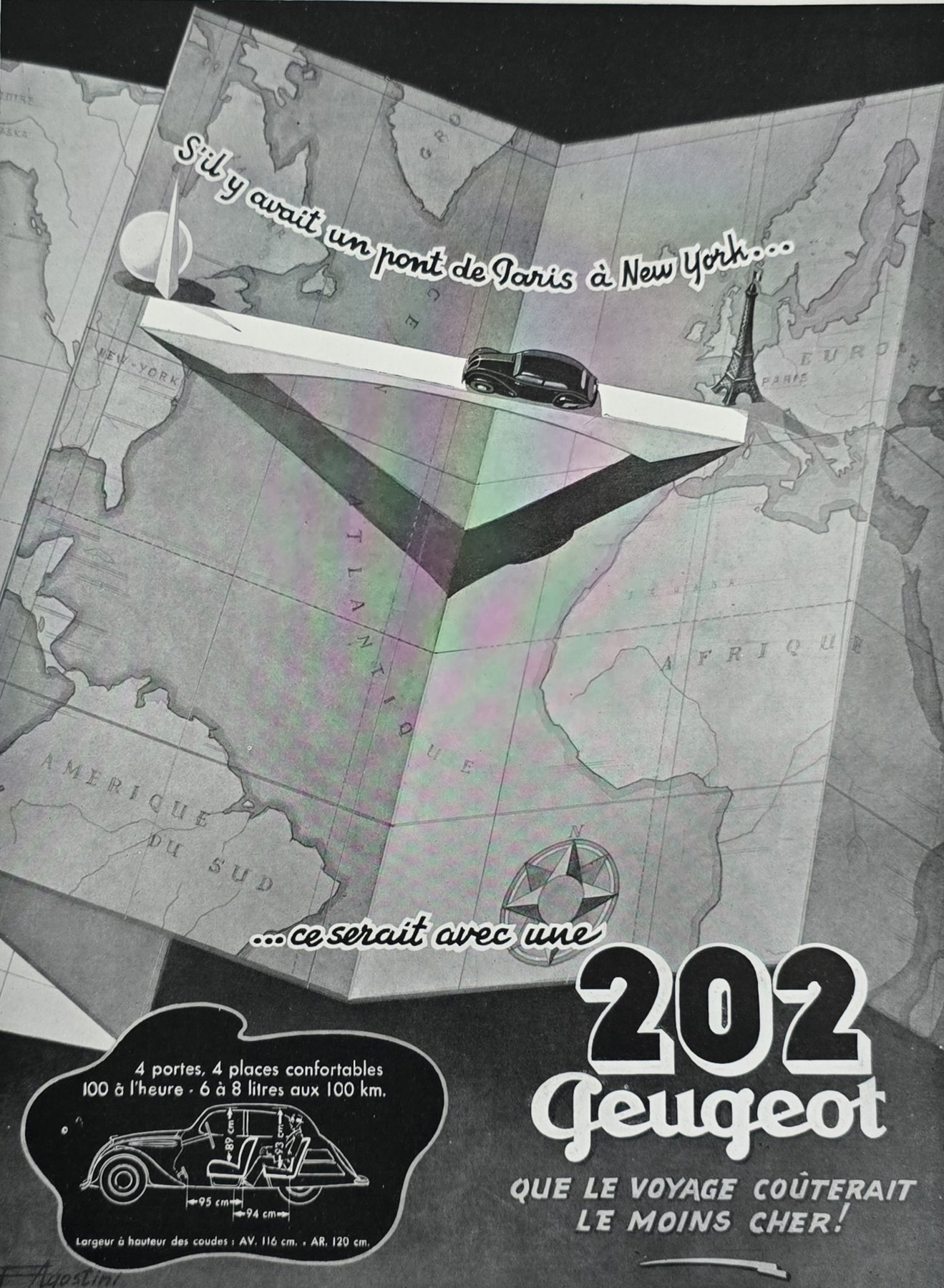
1939 French magazine ad for the Peugeot 202. A folded world map with a white bridge stretched across the Atlantic from a small Eiffel Tower to the Trylon and Perisphere of the New York World's Fair, with a small black car driving across. Script headline about a bridge from Paris to New York, the large logo “202 Peugeot” and a cutaway drawing of the car's interior.

“S'il y avait un pont de Paris à New York… ce serait avec une 202 Peugeot que le voyage coûterait le moins cher!”: if there were a bridge from Paris to New York, the 202 would be the cheapest way to cross it. In July 1939, a little black car drove across the Atlantic on an imaginary bridge, from the Eiffel Tower to the Trylon and Perisphere, the symbols of the New York World's Fair.

Peugeot, a family firm from the Montbéliard area that had made tools and bicycles, built its first cars at the end of the 19th century. The 202, launched in 1938, offered four doors, four seats, 100 km/h and 6 to 8 litres per 100 km.

Production was interrupted by the war and resumed until 1949.

Peugeot is now part of the Stellantis group.

Text in the ad

S'il y avait un pont de Paris à New York…
… ce serait avec une 202 Peugeot QUE LE VOYAGE COÛTERAIT LE MOINS CHER !
4 portes, 4 places confortables · 100 à l'heure · 6 à 8 litres aux 100 km.
Largeur à hauteur des coudes : AV. 116 cm. · AR. 120 cm.

Translation:
If there were a bridge from Paris to New York…
… it is with a Peugeot 202 THAT THE JOURNEY WOULD COST THE LEAST!
4 doors, 4 comfortable seats · 100 km/h · 6 to 8 litres per 100 km.
Width at elbow height: front 116 cm · rear 120 cm.

Brand
Peugeot
Year
1939
Decade
1930s
Country
France
Medium
Magazine
Themes
Cars
Original publication
Plaisir de France, juillet 1939
Peugeot 202 | 1939 · Vintage Ad Museum
{{ T.heroEyebrow }}

{{ T.heroTitle }}

{{ T.heroLede }}

{{ T.weekPiece }} {{ h.title }} {{ h.meta }} {{ h.excerpt }}

{{ T.browse }}

{{ totalLine }}

{{ T.byDecade }}

{{ T.byCountry }}

{{ T.byTheme }}

{{ T.byMedium }}

{{ T.seriesLabel }}

{{ T.natal }}

{{ T.natalLede }}

{{ T.seriesLabel }}

{{ T.didYouKnow }}

{{ T.latest }}

{{ T.archiveEyebrow }}

{{ T.nav.archive }}

{{ resultLine }}

{{ T.noResults }}

{{ T.timelineEyebrow }}

{{ T.nav.timeline }}

{{ T.timelineLede }}

{{ d.big }} {{ d.label }} · {{ d.count }}
{{ T.nav.about }}

{{ T.aboutTitle }}

{{ p }}

{{ T.founderLabel }}

{{ T.founder }}

Vintage Ad Museum · Museu da Propaganda, since 1999
{{ p.t }} {{ p.d }}
Vintage Ad Museum · Museu da Propaganda, since 1999
Vintage Ad Museum
{{ T.languages }}

{{ T.footerAbout }}

© 1999–2026 Vintage Ad Museum · Museu da Propaganda, since 1999 · vintageadmuseum.com{{ path }}
vintageadmuseum.com{{ path }}
{{ im.alt }} {{ zoomHint }}

{{ pv.title }}

{{ T.listen }}

{{ T.ptOnly }}

{{ p }}

{{ T.adTexts }}
{{ pv.adOrigLabel }}

{{ l }}

{{ T.translation }}

{{ l }}

{{ T.sensitive }}

{{ m.k }}
{{ m.v }}
{{ T.share }}
{{ r.title }}