Kellogg's | 1981
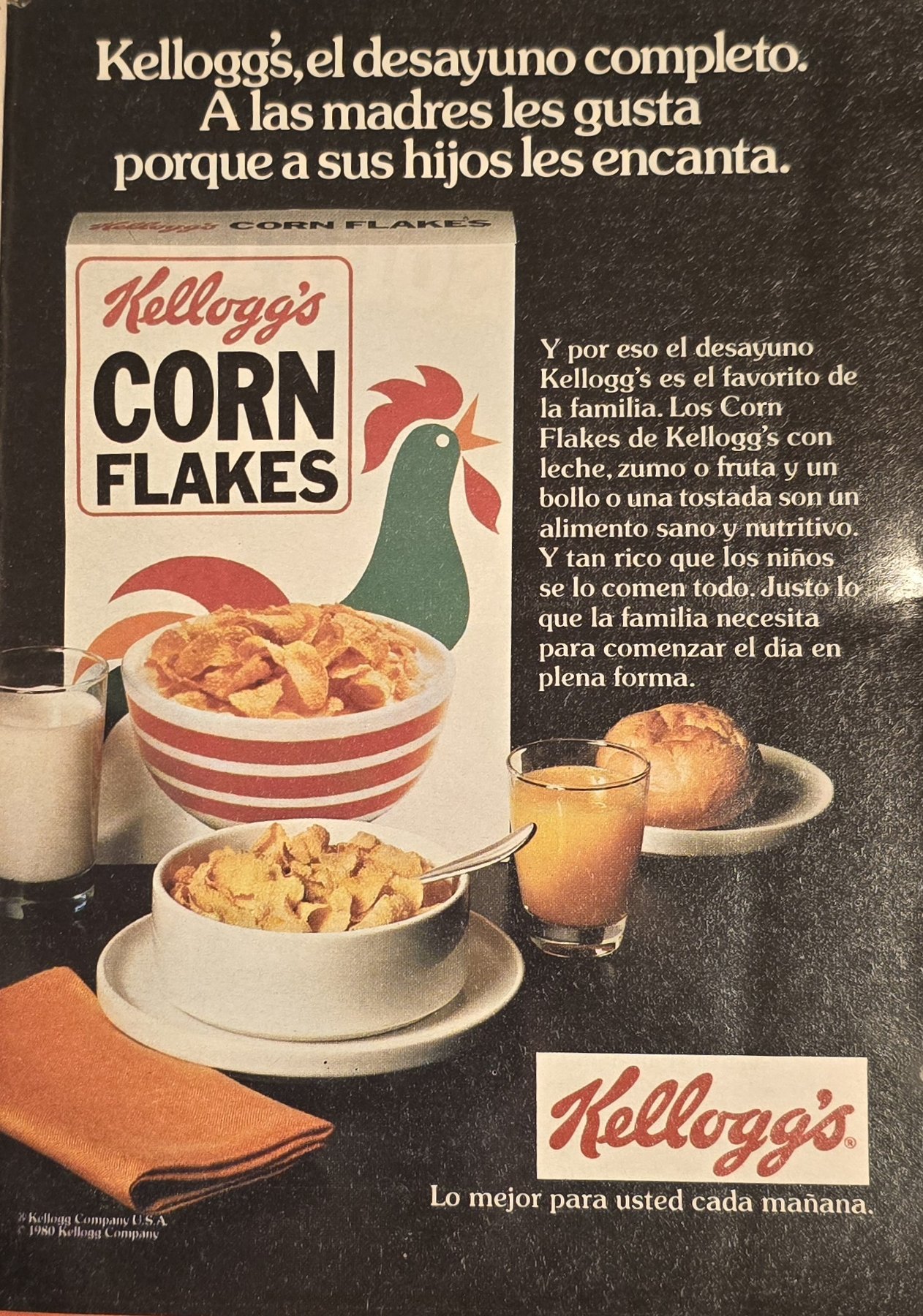
“A las madres les gusta porque a sus hijos les encanta” (Mothers like it because their children love it). That was how Kellogg’s Corn Flakes introduced themselves to Spanish readers in March 1981.
Corn flakes were born in Battle Creek, Michigan, at the sanitarium run by the physician John Harvey Kellogg. It was his brother, Will Keith Kellogg, who founded the company to sell them in 1906. Kellogg’s cereals reached Spain in 1977, and the factory in Valls, Catalonia, has been running since 1980.
In this ad we can see how the brand adapted to the Spanish breakfast: the bowl of cereal comes with milk, orange juice and a bollo, a soft bread roll. On the box is the green and red rooster, which first appeared in 1957. Many say the idea came from a Welsh harpist, because the Welsh word for rooster, ceiliog, sounds like Kellogg.
The headline is a portrait of its time, too: feeding the family was the mother’s job.
Since December 2025, Kellogg’s cereals sold outside North America have belonged to Mars.
Text in the ad
Kellogg’s, el desayuno completo. A las madres les gusta porque a sus hijos les encanta.
Y por eso el desayuno Kellogg’s es el favorito de la familia. Los Corn Flakes de Kellogg’s con leche, zumo o fruta y un bollo o una tostada son un alimento sano y nutritivo. Y tan rico que los niños se lo comen todo. Justo lo que la familia necesita para comenzar el día en plena forma.
Kellogg’s. Lo mejor para usted cada mañana.
Translation:
Kellogg’s, the complete breakfast. Mothers like it because their children love it.
That’s why a Kellogg’s breakfast is the family favourite. Kellogg’s Corn Flakes with milk, juice or fruit and a bun or a slice of toast make a healthy, nourishing meal. And so tasty that children eat it all up. Just what the family needs to start the day in top form.
Kellogg’s. The best for you every morning.
- Brand
- Kellogg's
- Year
- 1981
- Decade
- 1980s
- Country
- Spain
- Medium
- Magazine
- Themes
- Food
- Original publication
- Selecciones, 1981

