Globin | 1911
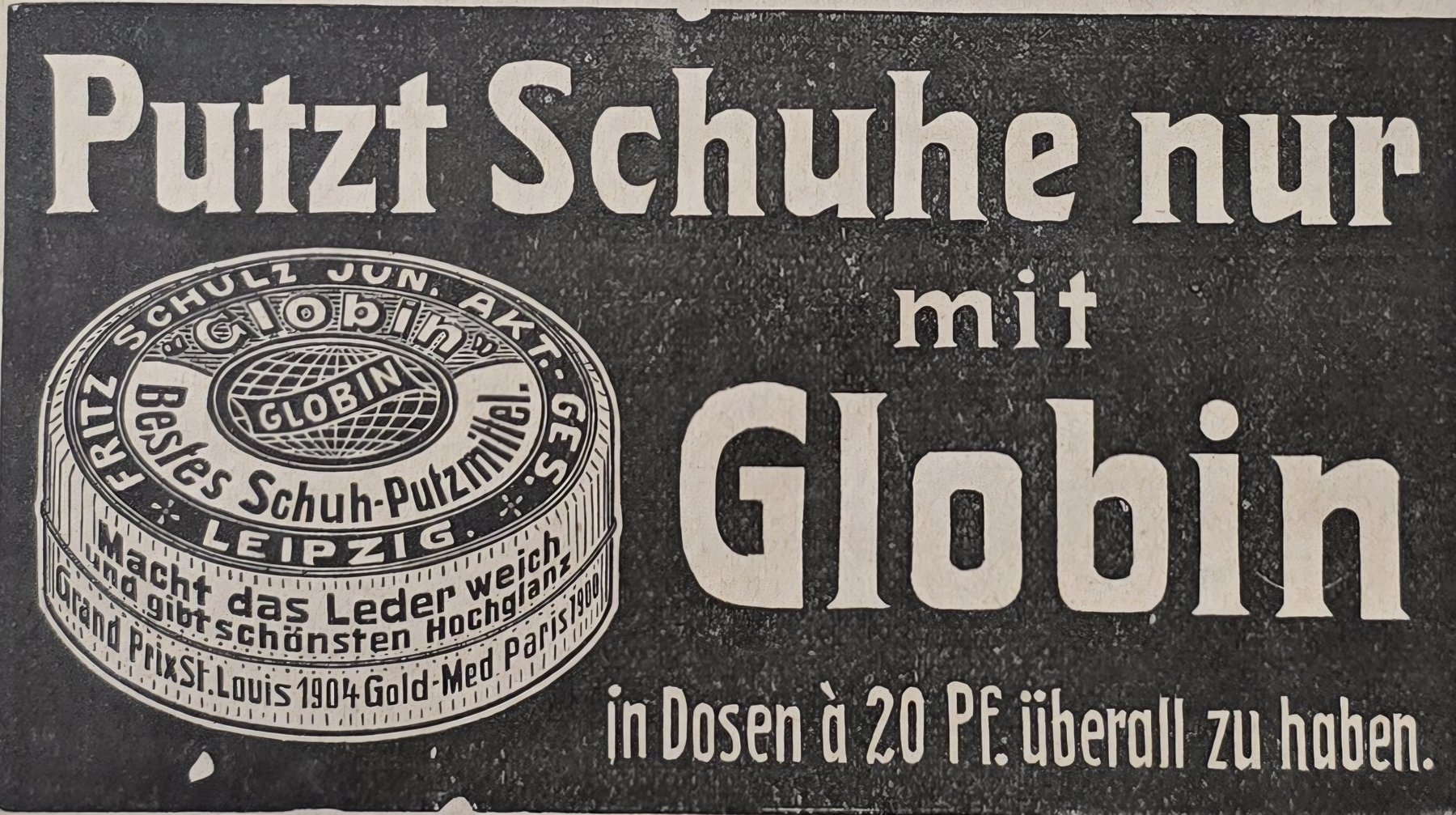
"Putzt Schuhe nur mit Globin" ("Polish your shoes with Globin only"). The message is blunt, set in white letters on a background as black as the polish itself.
Globin was made by Fritz Schulz jun., founded in Leipzig in 1878. The founder was apparently Gustav von Philipp, born in Triebel in eastern Germany, and the company name seems to come from his wife's family. In 1900 it became a joint-stock company known as the Globus-Werke, hence its family of "Glob" brands: Globin, Globol, Globella.
In this ad, published in 1911 in Die Hamburger Woche, an illustrated weekly from Hamburg, we can see that the tin displays medals from the World's Fairs in Paris (1900) and St. Louis (1904), used as a seal of quality. A tin cost 20 pfennigs, more than the magazine itself, which sold for 15.
The company once had subsidiaries in the United States and England, both seized during the First World War. After the Second, Leipzig found itself in East Germany and the factory was nationalized in 1949. After reunification, production came to an end.
Polishing shoes was a household ritual at a time when people walked a great deal and leather shoes had to last. The ritual lives on in the enamel signs showing Globin's round tin, still sought after by collectors.
Text in the ad
Putzt Schuhe nur mit Globin
in Dosen à 20 Pf. überall zu haben.
Dose: Fritz Schulz jun. Akt.-Ges., Leipzig · „Globin“ · Bestes Schuh-Putzmittel · Macht das Leder weich und gibt schönsten Hochglanz · Grand Prix St. Louis 1904 · Gold-Med. Paris 1900
Translation:
Polish your shoes with Globin only
in tins at 20 pf., available everywhere.
Tin: Fritz Schulz jun. AG, Leipzig · “Globin” · The best shoe polish · Softens the leather and gives the finest high gloss · Grand Prix St. Louis 1904 · Gold medal Paris 1900
- Brand
- Globin
- Year
- 1911
- Decade
- 1910s
- Country
- Germany
- Medium
- Magazine
- Themes
- Home
- Original publication
- Die Hamburger Woche, 1911

